Ceremony group size and staffing: how many is too many
When you look at a ceremony or retreat, the number of people in the room is easy to skip past. Websites talk about the facilitator, the setting and the tradition. They rarely say how many guests share one helper on a hard night. Yet that number decides what happens to you if you need help, and what happens to everyone else while someone is helping you.
This guide explains why group size and staffing matter, what written numbers exist and where they come from, and what to ask. One thing up front: we looked for an agreed ratio of helpers to participants for ceremonies, from medical bodies and harm-reduction groups, and didn’t find one. The numbers below come from research protocols and from one US state’s rules for its licensed psilocybin program. They are useful reference points, and nobody has shown that any particular ratio is safe for a ceremony.
Why the number of helpers matters
Most of the time, most people in a ceremony need very little. They lie down, sit up, go to the bathroom, perhaps vomit, and want to know someone is nearby. The strain on staff comes when one person needs a lot at once: they’re terrified, confused, trying to leave, or physically unwell.
Someone in that state needs a person with them, often for a long time. The Zendo Project, which trains people to support others through difficult psychedelic experiences, describes its approach as sitting with a person rather than guiding them, and accompanying them through the experience rather than trying to shut it down. That kind of support takes one helper’s full attention. Its training also covers assessing your own capacity before stepping in, which is a polite way of saying one helper can only do so much.
Support makes a measurable difference. In a 2016 survey of 1,993 people about their most difficult experience with psilocybin mushrooms, 11 percent said they had put themselves or others at risk of physical harm. That risk was lower among people who said the physical comfort of the setting and the social support during the session were good. Having a guide present was linked to shorter difficult experiences.
The Johns Hopkins team that published safety guidelines for psychedelic research in 2008 noted that the most likely risk is overwhelming distress, which could lead to dangerous behavior such as leaving the site. Someone has to be free to notice that and go after them.
The numbers that are written down
Research studies
The Hopkins guidelines recommend at least two monitors during each session, so that the volunteer is never alone if one monitor has to step out, for example to use the restroom. That’s two staff for one person.
Research on group formats has kept staffing high too. In a pilot study of psilocybin-assisted group therapy for older long-term AIDS survivors, published in 2020, the talking sessions were held in groups, but each participant took psilocybin in an individual session, in a separate room. A 2023 pilot study of group psilocybin therapy for people with cancer gave psilocybin in a group session to cohorts of four participants. Neither study is a ceremony, and neither sets a rule. They show how cautious researchers have been about putting people together while the drug is acting.
Oregon’s licensed psilocybin program
Oregon’s rules for licensed psilocybin service centers are the clearest public example of a group staffing rule we found. They say:
- A facilitator must be present for the whole administration session and must continuously monitor every client, keeping visual and audio contact. Video cameras don’t count.
- A facilitator may take a short restroom break only if they stay on the premises and another staff member is available to watch clients.
- For groups, there is a minimum ratio of facilitators to clients that depends on how much psilocybin the clients take, and the largest amount anyone in the group takes sets the ratio for everyone. At the lowest amounts, one facilitator may cover up to 25 clients. At the highest amounts the program allows, the ratio is one facilitator to two clients.
- No group session may have more than 25 clients, however many facilitators are present.
- The room must give each person at least 25 square feet, and enough space that clients don’t have to touch.
- Every client in a group must be able to ask for individual support from a facilitator, and facilitators must make reasonable efforts to move a disruptive client to a separate area.
- Before a group session, clients must be told about the safety issues of taking psilocybin alongside others, and must get a chance to meet every facilitator who will be there.
These rules apply only to Oregon’s licensed program, and only to psilocybin. A strong ayahuasca or 5-MeO-DMT ceremony is a different situation. What carries over is the principle: the stronger the experience, the fewer people each helper can look after.
What retreats actually do
Outside licensed programs, there is little data on staffing. A 2026 study interviewed 49 organizations that advertise psychedelic retreats. It didn’t report group sizes or ratios. It did find that 32 of them had someone with medical or emergency training on site at least occasionally, which leaves 17 that didn’t, and that 29 said their facilitators took psychedelics during ceremonies. Only four of those made a point of saying someone sober was always present.
One-on-one, small groups and large ceremonies
One-on-one
A private session gives you a helper’s full attention, and nobody else’s experience competes with yours. It also puts everything on one person. If they need to leave the room, make a phone call or deal with an emergency, there may be nobody else. Ask whether a second person is on site, and who it is.
Small groups
Many ceremonies run with somewhere between a handful and a dozen or so participants. Small groups can feel supportive, and a team of two or three sober helpers can usually keep everyone in view. The question is what happens when two people need help at the same time. If there are two helpers and one is leading the music or the ritual, there may only be one person free.
Large ceremonies
Some ceremonies, retreats and church services bring together dozens of people. Large groups can work when the staffing grows with them: more helpers, clear roles, a separate quiet space and a plan for several people struggling at once. They go badly when one leader runs the whole room with a couple of assistants. In a big room it’s also harder to notice the quiet person who has gone very still, or the person who slipped out.
Another person’s distress can be hard to sit next to. Oregon’s informed consent form asks group clients to acknowledge that others in the room may react to the experience in a different way. Ask how a center handles someone who is loud or very distressed, and whether you can move if you need to.
What happens when one person struggles
Picture a ceremony of twenty people with one leader and two helpers. One participant panics and needs someone beside them. One helper goes. Another participant needs to be walked to the bathroom, unsteady on their feet. The second helper goes. The leader is now the only person watching eighteen people, while also running the ceremony.
Nothing in that scene is unusual. It’s why you should ask:
- How many helpers are free to give one person their full attention, apart from the person leading?
- Is there a separate, safe space where someone can be looked after away from the group, with a staff member present?
- Who goes with people to the bathroom, and who watches the door?
- What happens if two or three people need help at once?
- Who decides to call emergency services, and who would drive if needed?
Our guide to what a center’s emergency plan should cover goes further into medical emergencies.
Who counts as a helper
A helper who is high is a participant. Oregon’s rules forbid licensed staff from consuming any intoxicant on duty or being under its influence on the premises. In traditions where the leader drinks or eats the medicine too, ask who else in the room stays sober for the whole night.
A helper should also know what to do. Ask what training each helper has, in supporting difficult psychedelic experiences and in first aid. Volunteers and former participants can be wonderful helpers, if they have been trained and know they are on duty.
Questions to ask before you book
- How many participants will there be, at most?
- How many staff will be present for the whole ceremony, and what does each one do?
- Which of them stay sober?
- Who has first aid or medical training, and is a medical professional on site or on call?
- What happens if someone needs one-to-one support for hours?
- What happens if more than one person needs help at once?
- Is there a separate space for someone who is struggling?
- Does the number of staff change on nights with a stronger medicine or a larger group?
- Can I meet the people who will be in the room before the ceremony?
Red flags
- The center won’t say how many people will attend, or the number on the night is much larger than you were told.
- One leader for a large group, with no helpers.
- Every member of staff takes the medicine.
- Helpers are “whoever is around,” with no training and no assigned role.
- No separate space and no plan for a person in distress, or “the group will hold them.”
- The answer to “what if two people struggle at once?” is that it never happens.
Good answers are specific: a number of guests, a number of sober staff, names and roles, and a plan for a bad night. A place that has thought about staffing will usually be glad you asked.
More guides
- What a center’s emergency plan should cover
- Facilitators: what experience and training look like
- Questions to ask before you book
- A multi-day retreat or a one-night ceremony?
- Red flags: when to walk away
Reviews are one of the few places you’ll learn how a center is staffed in practice: how many people were in the room, who stayed sober and how quickly someone came when a guest needed help. You can search the Safe Ceremonies listings and read past participants’ reviews, including ayahuasca and psilocybin and mushroom ceremonies. If you’ve been to one, saying how many people were there and how many staff helps the next person decide.
Sources
- Johnson MW, Richards WA, Griffiths RR (2008). Human hallucinogen research: guidelines for safety. Journal of Psychopharmacology. https://pmc.ncbi.nlm.nih.gov/articles/PMC3056407/
- Carbonaro TM, Bradstreet MP, Barrett FS, et al. (2016). Survey study of challenging experiences after ingesting psilocybin mushrooms. Journal of Psychopharmacology. https://pmc.ncbi.nlm.nih.gov/articles/PMC5551678/
- Oregon Administrative Rules, Chapter 333, Division 333 (Psilocybin), including 333-333-5020 (group session preparation), 333-333-5200 (administration session requirements), 333-333-5230 (group administration sessions) and 333-333-6000 (prohibited conduct), and 333-333-5040 (informed consent form). Checked 22 October 2026. https://secure.sos.state.or.us/oard/displayDivisionRules.action?selectedDivision=7102
- Anderson BT, Danforth A, Daroff PR, et al. (2020). Psilocybin-assisted group therapy for demoralized older long-term AIDS survivor men: an open-label safety and feasibility pilot study. EClinicalMedicine. https://pmc.ncbi.nlm.nih.gov/articles/PMC7599297/
- Lewis BR, Garland EL, Byrne K, et al. (2023). The HOPE pilot study of group psilocybin therapy in patients with cancer. Journal of Pain and Symptom Management, 66(3). https://pubmed.ncbi.nlm.nih.gov/37302533/
- McGuire AL, Neitzke-Spruill L, Robinson JO, et al. (2026). Reported safety practices of publicly advertised psychedelic retreats. JAMA Network Open. https://pmc.ncbi.nlm.nih.gov/articles/PMC12780929/
- Zendo Project. About, and the four principles of psychedelic care. https://zendoproject.org/about/
- Zendo Project. Playa kit (training outline). https://zendoproject.org/resources/playa-guide
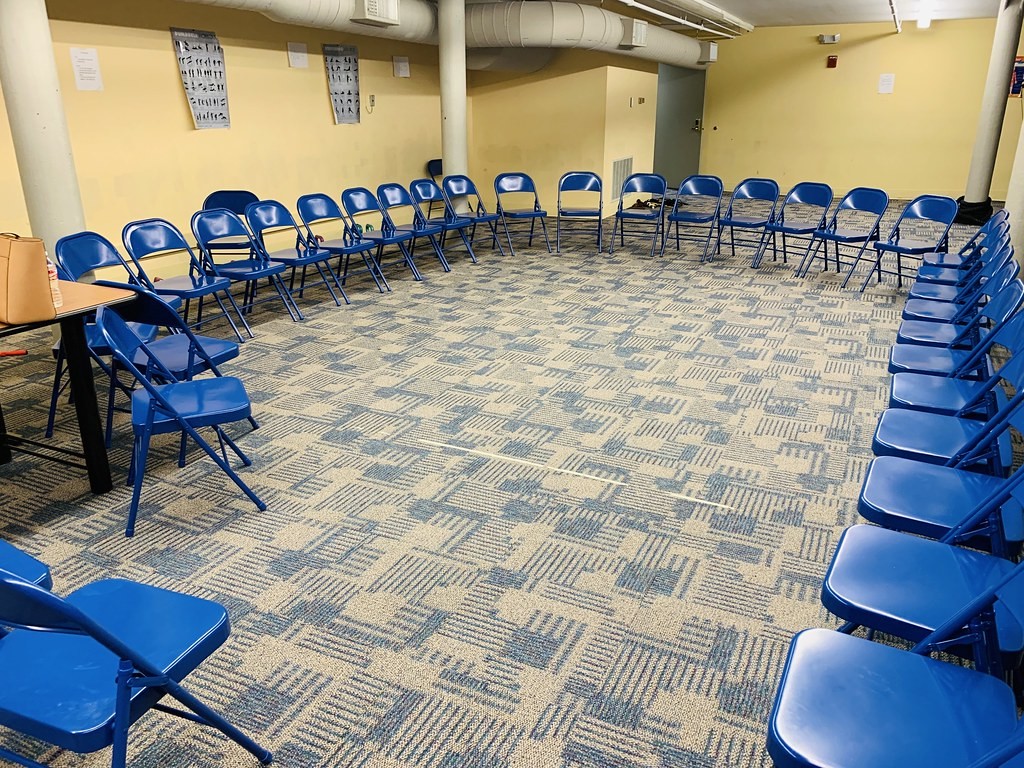
Photo: Circle of Chairs | Parentcamp Crossroads Preparatory Academy | Crossroads Charter Schools (Kansas City, Missouri) by LauraGilchristEdu, CC BY 2.0.

Author: Safe Ceremonies
User reviewed ceremonies