Grounded or woo woo? Reading a ceremony group’s beliefs
Every ceremony group has a worldview. Some describe their work in the language of a religious tradition, some in the language of psychology, some in a mix of the two, and some in terms borrowed from physics or the wellness industry. You don’t have to share a group’s beliefs to sit with it safely. What you need to know is how those beliefs shape the way it treats you, especially when something goes wrong.
“Woo woo” is a loose and slightly mocking term for claims that sound spiritual or scientific and can’t be checked. This guide has no quarrel with anyone’s faith. A traditional ceremony with prayers, songs and talk of spirits is a religious practice, and it can be run with great care. The concern here is narrower: beliefs that start making factual claims about your body and mind, or that start standing in for the practical parts of safety.
Beliefs and claims are different things
A belief describes how a group understands the world. The plant is a teacher, the ceremony is a prayer, the breath connects you to something larger. You can take it or leave it, and it doesn’t need proof.
A claim says what will happen to you. This will cure your depression, heal your trauma in one night, reset your nervous system, detox your liver. Claims about health can be tested, and most of the ones ceremony centers make never have been. Clinical research on psychedelics is active, but those studies use screened volunteers, trained staff and careful follow-up, and their results don’t carry over to a weekend retreat. For some substances there is very little human research of any kind. A 2022 review of 5-MeO-DMT, the main psychedelic compound in bufo ceremonies, found that clinical studies in humans were lacking.
A grounded group keeps the two apart. It might say, “Many people tell us the ceremony helped them see their grief differently,” and leave it there. A group that has drifted says, “This medicine heals grief at the cellular level.”
Signs a group is grounded
- It describes what past participants report without promising you the same.
- It tells you about risks in plain words and puts them where you’ll find them.
- It wants your medical history and respects what your doctor tells you.
- It treats a medical emergency as a medical emergency, whatever its spiritual reading of the moment.
- It lets you keep your own beliefs. You can be an atheist, a Christian or simply unsure, and still be welcome.
- It can tell you where a practice comes from and what is known about it, including what isn’t.
- It says “we don’t know” when it doesn’t know.
- Questions are welcome, and doubt is treated as normal.
Signs a group has drifted into woo
- Health promises, such as cures for cancer, addiction or depression, or for “all disease.”
- Science words used as decoration: frequencies, quantum healing, DNA activation, vibration, detox, with nothing you could look up.
- Every difficulty explained in spiritual terms. A seizure becomes a “purge,” panic becomes “resistance,” a racing heart becomes “energy moving.”
- “The medicine will protect you” or “the spirits choose who comes,” used to wave away screening.
- General suspicion of doctors, psychiatry and medication, or advice to stop your prescriptions.
- “It’s natural, so it’s safe.” The US National Center for Complementary and Integrative Health has a whole page on why natural doesn’t necessarily mean safer.
- Your experience is interpreted for you, and the meaning always happens to fit the group’s teaching.
- Talk of secret knowledge that outsiders “aren’t ready” to hear.
Why beliefs matter more in a ceremony
Under the influence of a psychedelic, people may be more open to suggestion. In a small placebo-controlled study, ten volunteers given LSD scored higher on a standard test of suggestibility than when they were given a placebo. That was one substance, in a lab, with very few people, and it shouldn’t be stretched too far. It is still a reason to care about what will be said to you in that state.
Beliefs can also outlast the ceremony. A 2021 study that surveyed people before and after psychedelic use found that their beliefs about the nature of reality and consciousness moved away from materialist views, and that most of these shifts lasted at least six months. The researchers linked the size of the shifts to how impressionable people were beforehand and to how emotionally in tune they felt with others during the experience.
So it makes sense to choose a group whose way of talking about the world you’d be comfortable carrying home. Its worldview will be in the songs, the talks and the way staff explain what’s happening to you. If you’d reject it with a clear head, think about whether you want to hear it while your mind is wide open.
The cost of “it’s all part of the process”
The most harmful kind of woo is the kind that reframes harm. Vomiting is a normal effect of some ceremonies, and many traditions treat it as cleansing. That’s a belief, and a harmless one. The trouble starts when the same frame is stretched over signs that need a doctor: chest pain, a seizure, trouble breathing, someone who can’t be woken.
It gets stretched over psychological harm too. If someone is still struggling weeks later, telling them they “aren’t integrating” or “need another ceremony” can keep them away from other help. When researchers asked professionals who support people through lasting difficulties after psychedelic experiences, the most frequent recommendations were individual therapy, grounding and mindfulness practices, and peer or community support, with short-term psychiatric medication in some cases. A grounded group will point you to those when you need them.
How to read a website or a conversation
- Note every promise about your health. For each one, ask how they could know.
- Look for a page about risks. If you have to hunt for it, or there isn’t one, write that down.
- Find the screening process. Grounded groups describe it. Others skip it or describe it as intuition (“we feel into whether you’re ready”).
- Read the About page for where the facilitators trained, in what and with whom.
- Count the borrowed science words. “Frequency,” “quantum,” “vibration” and “detox” on a page with no sources are a hint.
- Read testimonials as testimonials. They tell you how people felt, which is worth knowing, and they aren’t evidence of what a ceremony will do for your health.
Questions to ask about beliefs
- What do you believe happens in a ceremony? Do participants need to share that belief?
- What do you say to someone who has a frightening or painful experience?
- How do you decide whether something is a spiritual process or a medical problem?
- What happens if I disagree with how you interpret my experience?
- What do you say about health benefits, and what is that based on?
- Do you ever give people advice about their prescribed medicines?
Good answers are specific, comfortable with disagreement, and quick to bring in medical help. If you come away feeling that your questions proved you “aren’t ready,” or that doubt is something to be cured, you’ve learned how the group treats people who think for themselves. Our guide on leadership, lineage and cult warning signs looks at that side more closely.
A mixed picture is normal
Few groups are entirely grounded or entirely woo. A center might run excellent screening and still use a lot of energy language in its talks. Another might describe its work in careful psychological terms and still skimp on aftercare. Judge a group on the practical things first: screening, staffing, emergency planning, consent and aftercare. Then decide whether its way of talking about the world is one you can sit with for a night or a week.
More guides
- How to choose a ceremony center: a safety checklist
- Questions to ask before you book
- Red flags: when to walk away
- Leadership, lineage and cult warning signs
Reviews are often where a group’s style shows most clearly: how staff talked about hard moments, whether questions were welcome, what people were told afterwards. You can search the Safe Ceremonies listings and read past participants’ reviews across categories, from sound healing and cacao to psychedelic-assisted therapy.
Sources
- Ermakova AO, Dunbar F, Rucker J, Johnson MW (2022). A narrative synthesis of research with 5-MeO-DMT. Journal of Psychopharmacology. https://pmc.ncbi.nlm.nih.gov/articles/PMC8902691/
- Carhart-Harris RL, Kaelen M, Whalley MG, et al. (2015). A placebo-controlled study of LSD and suggestibility in ten healthy volunteers. Psychopharmacology, 232. https://doi.org/10.1007/s00213-014-3714-z
- Timmermann C, Kettner H, Letheby C, et al. (2021). Psychedelics alter metaphysical beliefs. Scientific Reports. https://pmc.ncbi.nlm.nih.gov/articles/PMC8611059/
- Argyri EK, Krecké J, Robinson OC, et al. (2025). Practitioner perspectives on extended difficulties and optimal support strategies following psychedelic experiences: a qualitative analysis. Harm Reduction Journal. https://pmc.ncbi.nlm.nih.gov/articles/PMC12870500/
- National Center for Complementary and Integrative Health. Know the science. https://www.nccih.nih.gov/health/know-science
- National Center for Complementary and Integrative Health. Natural doesn’t necessarily mean safer or better. https://www.nccih.nih.gov/health/know-science/natural-doesnt-mean-better
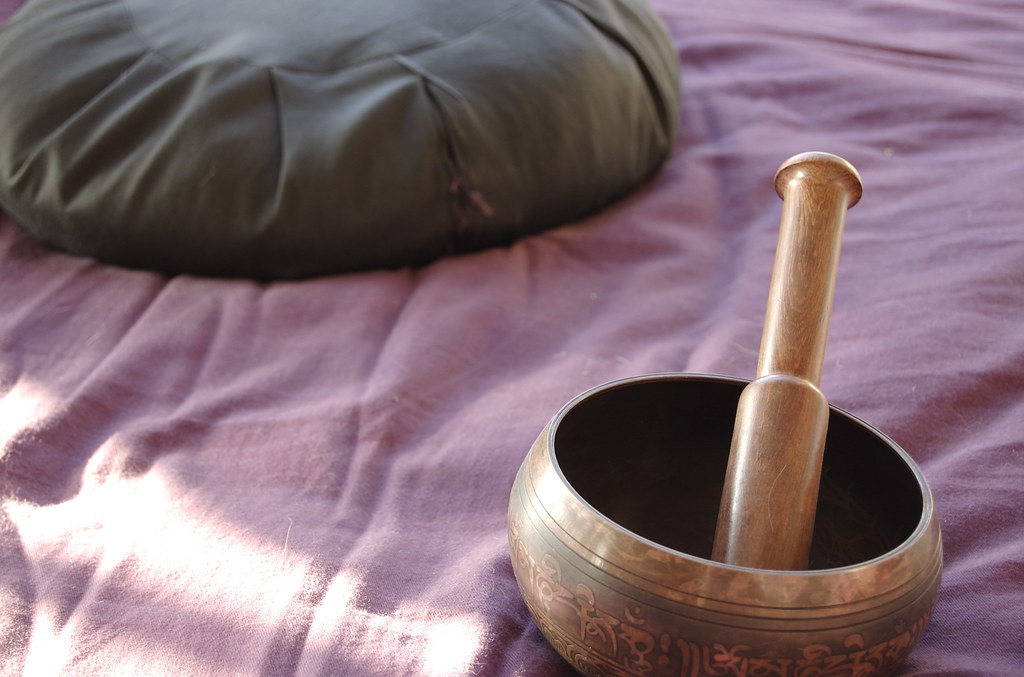
Photo: Singing Bowl and Cushion by teamaskins, CC BY-SA 2.0.

Author: Safe Ceremonies
User reviewed ceremonies