A short history of ceremonial plant use
Almost every ceremony center says its practice is ancient. Some of those claims are well supported. Some stretch the evidence, and a few are simply wrong. Knowing the real history helps you read a center’s story with a clear eye, and it explains why many Indigenous communities feel strongly about how their practices are used today.
This is a short overview, not a full history. Each tradition below belongs to particular peoples and places, and each has a far richer story than a few paragraphs can hold.
How we know what we know
Evidence about ceremonial plant use comes from a few kinds of source, and each has limits.
- Archaeology can date plant remains, carvings and objects, and chemical tests can sometimes detect the active compounds in them. It can show that a plant was used. It rarely shows how, or what it meant.
- Written accounts from the colonial period describe Indigenous ceremonies in the Americas, but they were mostly written by missionaries and officials who were trying to stamp those ceremonies out.
- Anthropology records how communities use these plants now and what they say about their own history.
- Communities’ own oral histories carry knowledge that outsiders’ records miss, and they belong to those communities to share or not.
So “used for thousands of years” can be a solid archaeological finding, a reasonable inference, or a marketing line. It’s fair to ask which.
Peyote: the oldest direct evidence
Peyote is a small, slow-growing cactus. In the United States it grows naturally only in a small area of south Texas, and peoples in what is now Mexico also used it. It has some of the oldest direct evidence of any ceremonial plant. Two dried peyote buttons, believed to come from a cave on the Rio Grande in Texas, were radiocarbon dated in a 2005 study to roughly 3780 to 3660 BC. Chemical analysis found mescaline, peyote’s main active compound, still present. The authors concluded that people in North America recognized peyote’s effects as long as 5,700 years ago.
In the modern era, peyote is the sacrament of the Native American Church, whose ceremonies are practiced across many tribal nations. Its legal story shows how fragile that protection has been. In 1990, in Employment Division v. Smith, the US Supreme Court ruled that the Constitution’s protection of religious freedom did not stop Oregon from denying unemployment benefits to two men fired for taking peyote at a Native American Church ceremony. Congress responded in 1994 by amending the American Indian Religious Freedom Act, making traditional ceremonial use of peyote by Indians lawful under federal and state law.
Today peyote is scarce. In 2020 and again in 2021, the presidents of the four largest Native American Church organizations and the Indigenous Peyote Conservation Initiative asked the wider psychedelic movement to leave peyote out of decriminalization campaigns. They pointed out that in the US peyote grows naturally in only a small area of south Texas, takes many years to mature, and is already in short supply for Native people. Our guide on peyote and conservation covers this in more detail.
Mushrooms in Mesoamerica
Several peoples of what is now Mexico and Central America used psilocybin mushrooms in religious and healing rites. A 2015 review of the archaeological and historical evidence describes the Aztec name teonanácatl, often translated as “flesh of the gods,” and carved “mushroom stones” found in ritual contexts, some dated to around 3000 BC. Spanish chroniclers of the 16th century, such as Fray Bernardino de Sahagún, described the mushrooms’ effects, and the Church treated their use as idolatry and tried to suppress it. The practice survived, quietly, in some communities.
The outside world learned of it in the 1950s, when the American R. Gordon Wasson and his wife took part in mushroom ceremonies led by the Mazatec healer María Sabina in Oaxaca and described them in Life magazine in 1957. The Swiss chemist Albert Hofmann isolated psilocybin from the mushrooms in 1958. Much of today’s psilocybin research and retreat culture traces back to that moment, which began with a ceremony shared by a Mazatec healer with outsiders.
San Pedro: a long Andean tradition
The San Pedro cactus, called huachuma in the Andes, also contains mescaline. A review of archaeological and historical evidence from northern Peru lists signs of its ritual use in a series of pre-Columbian cultures: the Cupisnique from around 1500 BC, Chavín from around 1000 BC, then Moche and Lambayeque.
The tradition continues. Healers in northern Peru still use San Pedro in healing rituals held in the early hours of the morning and built around a mesa, an altar of objects, with steps for diagnosing illness, cleansing and restoring the patient. That review describes the use as part of Andean healing practice up to the present day.
Ayahuasca in the Amazon
Ayahuasca is a brew usually made from a vine, Banisteriopsis caapi, and the leaves of another plant that contain DMT. Many Amazonian peoples use it in healing, initiation and spiritual practice. Its exact age is hard to pin down, because a liquid leaves few traces.
The clearest early evidence so far comes from a ritual bundle found in a rock shelter in the Bolivian highlands and dated to about 1,000 years ago. A 2019 chemical analysis found traces of DMT and harmine, the two main active compounds in ayahuasca, along with cocaine and bufotenine. The plants that contain these compounds grow in very different regions, so the authors concluded that ritual plants and knowledge about them moved across long distances. The find shows that both ayahuasca ingredients were part of one ritual kit. It doesn’t prove the brew itself was made the way it is today.
In the 20th century, ayahuasca also became the sacrament of new religions in Brazil. Santo Daime was founded in the 1930s in the Amazonian state of Acre by Raimundo Irineu Serra, a rubber tapper, and blends Indigenous plant practice with folk Catholicism, spiritism and Afro-Brazilian religion. The União do Vegetal is another Brazilian ayahuasca church. In 2006 the US Supreme Court ruled unanimously that the federal government had not justified banning the UDV’s American branch from using its sacramental tea under the Religious Freedom Restoration Act.
In 2008, Peru’s National Institute of Culture declared the knowledge and traditional uses of ayahuasca practiced by native Amazonian communities part of the nation’s cultural heritage. The declaration explicitly set that traditional, sacred use apart from Western uses taken out of context, consumerist or commercial.
Iboga and the Bwiti tradition
Iboga, a shrub that grows mostly in Gabon, is central to Bwiti, a spiritual and initiatory tradition in Gabon. Iboga has drawn outside interest because one of its compounds, ibogaine, is being studied for addiction. That interest has put pressure on wild plants. In 2022, Gabon completed the first phase of a legal export arrangement under the Nagoya Protocol, an international treaty on sharing the benefits of genetic resources with the communities they come from.
Kambo in the western Amazon
Kambo is the secretion of a large Amazonian tree frog. A 2022 review lists more than 15 Indigenous groups across several South American countries that traditionally used it, often by hunters, to build strength and ward off panema, a kind of bad luck or weakness. The frogs are released after the secretion is collected. Use spread to rubber tappers in the 19th century and, from the early 2000s, to cities in Brazil and then to Europe and North America, usually far from its original context.
Bufo: a recent practice
Ceremonies using the dried secretion of the Sonoran Desert toad are often presented as ancient. A 2022 review of 5-MeO-DMT research, the toad’s main psychedelic compound, found no conclusive evidence that Indigenous peoples used this toad for its psychoactive effects before the 1980s. Plants containing 5-MeO-DMT do have a long history of use in South America. Smoking the toad’s secretion appears to be a modern practice.
Prohibition and revival
Most psychedelic substances were banned in the early 1970s, and research on them was limited for decades. A few traditional and religious uses later won specific legal protection in the US, such as peyote in Native American Church ceremonies and the UDV’s sacramental tea. Many others stayed in a legal gray zone or out of sight. The current wave of research and retreats grew from the 2000s onward, and with it came new questions about who benefits from traditions that began with Indigenous peoples.
What this history means for you
- When a center says its practice is ancient, ask what tradition it comes from and how the facilitators learned it.
- Being old doesn’t make something safe. Traditional settings developed their own safeguards, which a retreat may or may not keep.
- Many of these plants and animals are under pressure from demand. Peyote and iboga are scarce, and the Sonoran Desert toad has been described by researchers as under severe ecological pressure.
- Legal protections usually apply to particular communities and churches. They don’t make a practice legal for everyone.
Our guide on Indigenous traditions and respectful practice looks at what communities themselves have asked of outsiders.
More guides
- Indigenous traditions and respectful practice
- Reciprocity and sustainability: the plants and the people behind them
- What peyote is, and why conservation matters
- What ayahuasca is
- Kambo vs bufo: two “frog medicines” that often get confused
- Ayahuasca vs San Pedro
If a center’s history matters to you, past participants’ reviews often mention who leads ceremonies and how the tradition is honored. You can search the Safe Ceremonies listings, including ayahuasca, San Pedro and huachuma and peyote and iboga.
Sources
- El-Seedi HR, De Smet PA, Beck O, Possnert G, Bruhn JG (2005). Prehistoric peyote use: alkaloid analysis and radiocarbon dating of archaeological specimens of Lophophora from Texas. Journal of Ethnopharmacology. https://doi.org/10.1016/j.jep.2005.04.022
- Employment Division, Department of Human Resources of Oregon v. Smith, 494 U.S. 872 (1990). Legal Information Institute, Cornell Law School. https://www.law.cornell.edu/supremecourt/text/494/872
- 42 U.S. Code § 1996a, Traditional Indian religious use of peyote. Legal Information Institute, Cornell Law School. https://www.law.cornell.edu/uscode/text/42/1996a
- National Council of Native American Churches and Indigenous Peyote Conservation Initiative (2020). Native American statement regarding decriminalization of peyote. Chacruna. https://chacruna.net/native-american-statement-regarding-decriminalization-of-peyote/
- National Council of Native American Churches and Indigenous Peyote Conservation Initiative (2021). Open letter to the psychedelic movement regarding peyote in policy efforts and how to be an ally to Indigenous peoples of North America. Chacruna. https://chacruna.net/ipci_open_letter_psychedelic_movement_peyote_decriminalization/
- Carod-Artal FJ (2015). Hallucinogenic drugs in pre-Columbian Mesoamerican cultures. Neurología. https://doi.org/10.1016/j.nrl.2011.07.003
- Skalski P, Pękacka-Falkowska K, Pluto-Prądzyńska A, Owecki MK (2026). Psilocybin in neuropsychiatric disorders: seeking valuable evidence in history, pure science, clinical trials and real-world data. Brain Sciences. https://pmc.ncbi.nlm.nih.gov/articles/PMC13115139/
- Carod-Artal FJ, Vázquez-Cabrera CB (2006). Mescaline and the San Pedro cactus ritual: archaeological and ethnographic evidence in northern Peru. Revista de Neurología. https://doi.org/10.33588/rn.4208.2006040
- Miller MJ, Albarracin-Jordan J, Moore C, Capriles JM (2019). Chemical evidence for the use of multiple psychotropic plants in a 1,000-year-old ritual bundle from South America. PNAS. https://pmc.ncbi.nlm.nih.gov/articles/PMC6561276/
- Hartogsohn I (2021). Set and setting in the Santo Daime. Frontiers in Pharmacology. https://pmc.ncbi.nlm.nih.gov/articles/PMC8129555/
- Gonzales v. O Centro Espírita Beneficente União do Vegetal, 546 U.S. 418 (2006). Legal Information Institute, Cornell Law School. https://www.law.cornell.edu/supct/html/04-1084.ZS.html
- Labate BC (2008). Ayahuasca is declared cultural patrimony of Peru (with the text of National Directorial Resolution No. 836/INC). https://www.bialabate.net/blog-archive/news/ayahuasca-is-declared-cultural-patrimony-of-peru
- Iyer RN, Favela D, Zhang G, Olson DE (2021). The iboga enigma: the chemistry and neuropharmacology of iboga alkaloids and related analogs. Natural Product Reports. https://pmc.ncbi.nlm.nih.gov/articles/PMC7882011/
- Lucid News (2022). Gabon takes first step toward legal export of sustainable iboga. https://www.lucid.news/gabon-takes-first-step-toward-legal-export-of-sustainable-iboga/
- Nogueira TAC, Kaefer IL, Sartim MA, et al. (2022). The Amazonian kambô frog Phyllomedusa bicolor: current knowledge on biology, phylogeography, toxinology, ethnopharmacology and medical aspects. Frontiers in Pharmacology. https://pmc.ncbi.nlm.nih.gov/articles/PMC9582840/
- Ermakova AO, Dunbar F, Rucker J, Johnson MW (2022). A narrative synthesis of research with 5-MeO-DMT. Journal of Psychopharmacology. https://pmc.ncbi.nlm.nih.gov/articles/PMC8902691/
- Vamvakopoulou IA, Narine KAD, Campbell I, Dyck JRB, Nutt DJ (2023). Mescaline: the forgotten psychedelic. Neuropharmacology. https://doi.org/10.1016/j.neuropharm.2022.109294
- Lerer L, Reynolds E, Varia J, Blakolmer K, Lerer B (2023). Incilius alvarius cell-based synthesis of 5-methoxy-N,N-dimethyltryptamine. Psychedelic Medicine. https://pmc.ncbi.nlm.nih.gov/articles/PMC11658656/
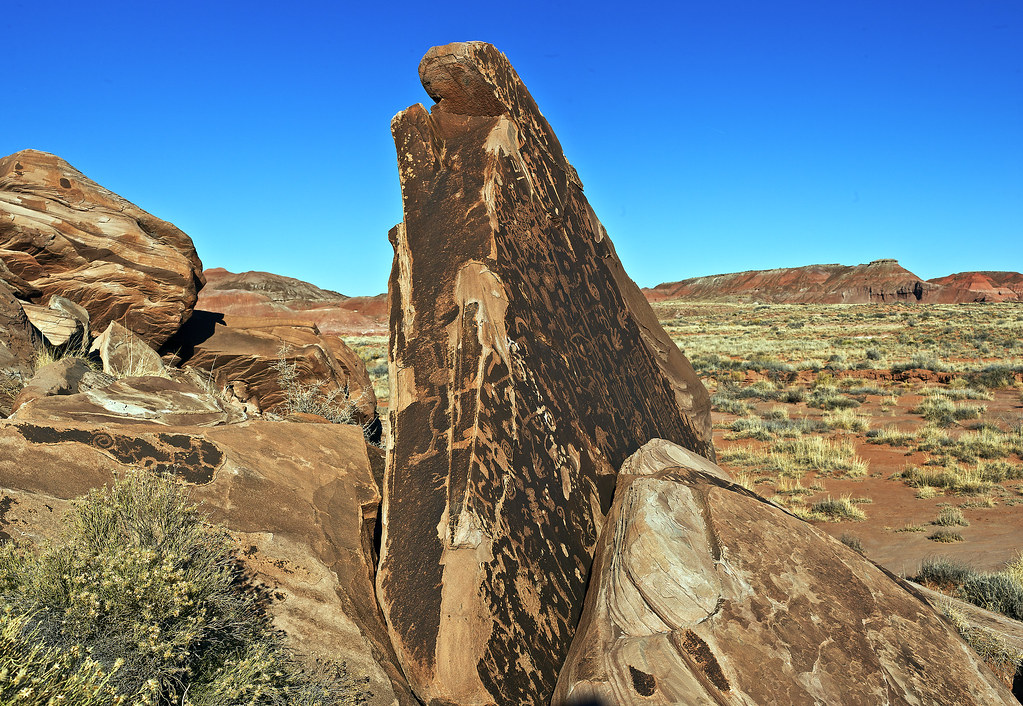
Photo: Flatiron Petroglyph Panel by NPS / Andrew V Kearns (Petrified Forest National Park), Public Domain Mark 1.0.

Author: Safe Ceremonies
User reviewed ceremonies