Ayahuasca churches: what they are and what to ask
People search for an “ayahuasca church near me” for different reasons. Some want a religious community. Some have read that a church is safer or more legitimate than a retreat. Some want something close to home that doesn’t involve a flight. The word “church” can’t settle any of those questions, because it covers very different groups.
This guide explains what the label can mean, what it does and doesn’t tell you about safety, and what to ask before you join. It doesn’t argue for churches over other settings, or against them. Our guide to churches, retreats, circles and clinics compares the settings side by side. This guide was checked on 2026-10-30.
What “ayahuasca church” can mean
Three rough kinds of group use the word, and from a website they can look alike.
- A congregation of an established religion. Santo Daime, the União do Vegetal and Barquinha all began in Brazil in the 20th century, and each has its own teachings, music and structure. Our guide to ayahuasca traditions and lineages describes them.
- An independent church. A person or small group founds it, sometimes after training with a healer in South America, and it may blend several traditions with practices of its own.
- A retreat or ceremony business organized as a church. You may see package prices, a sales page and a membership form that arrives with the booking.
Any of these could be run with care or without it. The categories also overlap, so ask each group directly what it is and where it came from.
If you searched for Santo Daime
Santo Daime is a religion with its own hymnals and ceremonies, which it calls works. According to the World Religions and Spirituality Project, initiated members are known as fardados and wear uniforms. At festival works, people stand in set rows by gender, height, age and marital status, for six to twelve hours of singing and dancing. That is a very different night from sitting quietly in the dark with one healer, so find out what you’d be attending.
The movement split into several lines after its founder died in 1971. If a local group says it is Santo Daime, ask which line it belongs to and who in that line knows its leaders. Ask too whether visitors can attend and what is expected of them, because we can’t give you one rule that fits every group.
What “nonprofit” and “community-based” mean
Nonprofit is a tax status. The IRS says churches that meet the requirements of section 501(c)(3) are automatically considered tax exempt and don’t have to apply for recognition. Churches are also generally excepted from filing the annual return that most tax-exempt organizations file. So a real church may have no IRS letter and no public financial filings, and that alone isn’t a warning sign.
The IRS Tax Exempt Organization Search shows determination letters and filings for organizations that have them. It can confirm a group’s tax claim if the group says it has been recognized. It tells you nothing about how the group screens people or handles an emergency. Nonprofit also doesn’t mean free, or that nobody earns a living from the ceremonies, so ask.
We know of no official definition of “community-based.” Ask who the community is. Do members see each other outside ceremonies? How long have most of them belonged? Who makes decisions? A real community can look out for you after a hard night, and it can also make it harder to say no to the people you’ve come to rely on.
What the word “church” tells you about safety
It tells you how a group describes itself, and that you’ll probably be taking part in a religious practice. No safety standard comes attached to the word.
The research doesn’t settle the question either. In the Global Ayahuasca Survey, which drew more than 10,000 responses, people who drank in religious settings, mainly Brazilian ayahuasca churches, reported fewer adverse effects than people in other settings. Most of the religious-setting respondents were Brazilian, and the authors say the differences may partly reflect who those users are. It was also an online survey of people who chose to answer. Its results come mostly from long-established Brazilian churches, so they tell you little about a new group elsewhere that has taken the same name.
A 2026 study in JAMA Network Open interviewed 49 organizations that advertise psychedelic retreats, and it found wide differences in safety practices. It reports that two religious groups with no licensed or emergency-trained staff relied on sober volunteers in an emergency. That is two groups in a small study, and you can’t draw a conclusion about churches in general from it. It does show why you should ask this question of a church as you would of anyone else.
The legal question
Many groups present the church label as a legal answer. We don’t give a legal view here. Our guide to ayahuasca and US law describes the court cases and the federal exemption process, and it’s worth reading before you rely on anything a group says about its legal standing. Ask the group what its legal basis is, and compare the answer with that guide. If the answer matters to you, speak to a lawyer where you live.
What to ask
Ask these before you sign or pay anything. The same questions work for a retreat, a circle or a clinic.
Screening
- Do you ask about my health, my medicines and my mental health history before I’m accepted?
- Who reads my answers, and what are their qualifications?
- Have you ever turned someone away? For what reasons?
- Will someone talk to me about my medicines well before the ceremony?
Some medicines and health conditions make ayahuasca dangerous, which our guide to medications and health conditions covers. In the JAMA study, all 49 organizations collected medical histories, while 36 excluded people with certain conditions. A form on its own proves little, so find out what happens to your answers.
Facilitators
- Who will lead the ceremony? Where and with whom did they train, and for how long?
- Who is trained in first aid or emergency care, and will they be there all night?
- Do the leaders drink during ceremonies? If so, who stays sober?
- How many helpers are there for how many participants?
- Will you call 911 in an emergency? Has that ever happened here?
In some traditions, leaders drink as part of the ceremony, so asking isn’t an insult. In the JAMA study, 29 of the 49 organizations said facilitators took psychedelics during ceremonies. You want to know who in the room can drive, make a phone call and think clearly at 3 a.m.
Money
- What is the full cost for one ceremony, including any membership fee, and is a “donation” actually required?
- What happens if I can’t pay, or if I’m screened out after paying?
- Will I be asked for regular giving, paid levels or trainings later on?
- Who controls the money, and who owns the land and buildings?
- Are the leaders paid? Does anyone outside the leadership see the accounts?
Our guide to what ceremonies cost covers what should be in writing.
Leadership
- Who leads this church, and who can overrule them?
- Is there a board, a council of elders or a wider organization? Can I find out who they are?
- If I had a complaint about the leader, who would I take it to?
- Has a leader or helper ever been asked to step back? What happened?
- What is your rule on sexual or romantic relationships between leaders and participants?
The International Cultic Studies Association’s checklist lists a leader who isn’t accountable to any authority, and a group preoccupied with making money, among the patterns seen in cultic groups. The author says the list isn’t a cult scale, so use it to think with and don’t treat it as a verdict. A Chacruna Institute guide on sexual abuse in ayahuasca settings says the healer holds a position of power and responsibility, and that it’s the healer’s or facilitator’s job to stay out of relationships with participants. Our guide to leadership and cult warning signs goes further.
What a membership asks of you
- Can I read the membership form, any waiver and the statement of beliefs at home before I decide?
- What am I agreeing to believe or do by signing?
- Am I expected to keep what happens secret? From whom?
- How often am I expected to attend, volunteer or give?
- Can I come once and not return? How do I end my membership, and how do you treat people who leave?
Treat a membership form as you would any agreement. If it arrives minutes before a ceremony, when you’ve already traveled and paid, you have little room to say no. Ask for it earlier.
How to read the answers
Good answers are specific, and they come easily. “Our nurse is here all night, and we’ve called an ambulance once, in 2024” tells you something. So does “we have no medical staff, and here is what we do instead,” because you can weigh it. Be careful with answers that move the conversation to faith, such as being told that your questions show a lack of trust, or that the medicine will protect you. Talk to a former member if you can, since they can tell you what leaving costs.
If you’re looking close to home, our guide to finding a ceremony near you covers how to search and check a group. If something has already gone wrong for you, Fireside Project’s free psychedelic peer support line, 62-FIRESIDE (623-473-7433), takes calls and texts from 11 a.m. to 11 p.m. Pacific every day. If you’re in crisis in the US, call or text 988.
More guides
- Church, retreat, underground circle or clinic: what the differences mean
- Ayahuasca traditions: Shipibo, Santo Daime, UDV and more
- Is ayahuasca legal in the US? The religious-use cases
- Finding an ayahuasca ceremony near you
- Health screening: why a good center asks about your health
- What a center’s emergency plan should cover
Past participants can tell you how a group handled screening, money and hard nights, whatever it calls itself. You can search the Safe Ceremonies listings and read reviews in the ayahuasca and integration and aftercare categories.
Sources
- Barnard GW (2013). Santo Daime. World Religions and Spirituality Project. https://wrldrels.org/2016/10/08/santo-daime/
- Internal Revenue Service. Churches, integrated auxiliaries, and conventions or associations of churches. Page updated 28 June 2026, checked 30 October 2026. https://www.irs.gov/charities-non-profits/churches-integrated-auxiliaries-and-conventions-or-associations-of-churches
- Internal Revenue Service. Filing requirements for churches and religious organizations. Page updated 6 July 2026, checked 30 October 2026. https://www.irs.gov/charities-non-profits/churches-religious-organizations/filing-requirements-for-churches-and-religious-organizations
- Internal Revenue Service. Tax Exempt Organization Search. https://www.irs.gov/charities-non-profits/search-for-tax-exempt-organizations
- Bouso JC, Andión Ó, Sarris JJ, et al. (2022). Adverse effects of ayahuasca: results from the Global Ayahuasca Survey. PLOS Global Public Health, 2(11). https://journals.plos.org/globalpublichealth/article?id=10.1371/journal.pgph.0000438
- McGuire AL, Neitzke-Spruill L, Robinson JO, et al. (2026). Reported safety practices of publicly advertised psychedelic retreats. JAMA Network Open. https://jamanetwork.com/journals/jamanetworkopen/fullarticle/10.1001/jamanetworkopen.2025.52505
- Langone MD (2015). Revised checklist of the characteristics of cultic groups. ICSA Today, 6(3). https://articles1.icsahome.com/articles/characteristics
- Sinclair E, Labate BC (2019). Ayahuasca community guide for the awareness of sexual abuse (Chacruna Institute), via MAPS. https://maps.org/news/bulletin/ayahuasca-community-guide-for-the-awareness-of-abuse-2019/
- Fireside Project, psychedelic peer support line. https://firesideproject.org/
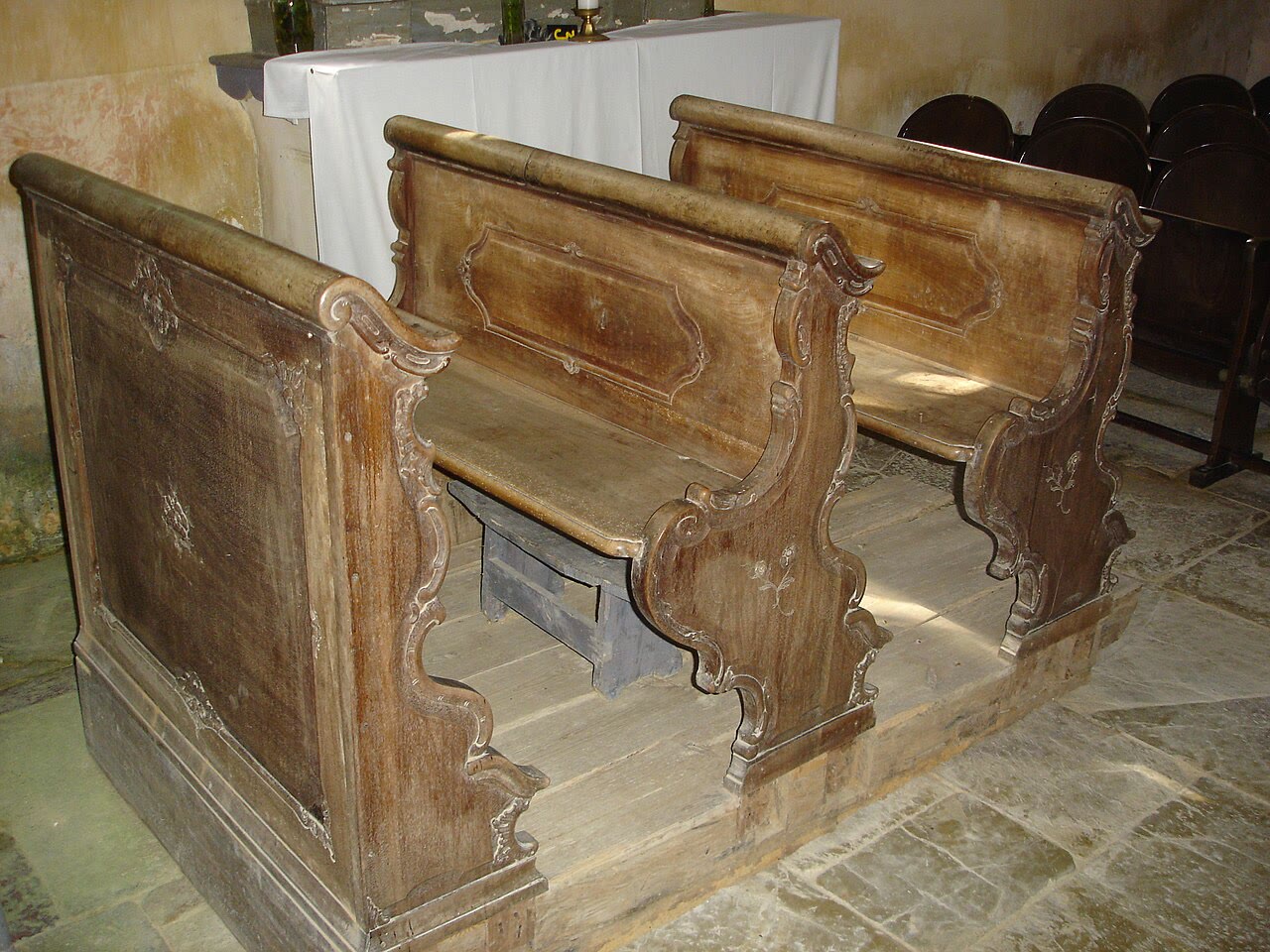
Photo: Chapel benches from Pišece Castle 01 by Janezdrilc, CC0 1.0.

Author: Safe Ceremonies
User reviewed ceremonies