What is ayahuasca? The brew, its history and its risks
Ayahuasca is a brew from the Amazon, usually made from two plants cooked together in water. People drink it in ceremonies led by Indigenous healers, by mestizo curanderos, by churches in Brazil and their branches abroad, and by a growing number of retreat centers around the world. The name comes from Quechua and is often translated as “vine of the soul” or “vine of the dead.”
This guide explains what is in the brew, how it acts in the body, where the practice comes from and what research has found so far. It doesn’t tell you how much to take or where to get it, and it can’t tell you whether ayahuasca is right for you. That conversation belongs with a doctor who knows your history and with a center that screens properly.
What’s in the brew
The usual recipe combines the stem bark of the Banisteriopsis caapi vine with the leaves of a shrub, most often Psychotria viridis (chacruna). Each plant does a different job.
- The leaves contain N,N-dimethyltryptamine, or DMT, the compound behind most of the visual and psychological effects.
- The vine contains harmine, harmaline and tetrahydroharmine, a group of compounds called harmala or beta-carboline alkaloids.
On its own, swallowed DMT does very little, because enzymes in the gut and liver called monoamine oxidases (MAO) break it down before it reaches the brain. Harmine and harmaline block one of those enzymes, MAO-A, for a while. That lets the DMT through. A review in Current Neuropharmacology describes these vine alkaloids as reversible MAO-A inhibitors, and notes that tetrahydroharmine also weakly blocks the reuptake of serotonin.
That pairing is why ayahuasca is more than “DMT you drink.” The vine has its own effects and is the part many traditions treat as the medicine itself. It is also the part that causes the most serious drug interactions, which comes up again below.
Brews vary. Healers use different vines, leaves and cooking methods, and some add other plants. Two cups from two places can differ a lot in strength and content, and you usually have no way of checking.
Where it comes from
Ayahuasca comes from the Amazon basin, where it has a long history in traditional medicine. How far back that history goes is hard to pin down. In 2019, archaeologists described a leather bundle from a cave in the Bolivian Andes, about 1,000 years old, holding a pouch made from fox snouts. Chemical tests found traces of DMT and harmine, the two key compounds in ayahuasca, along with cocaine and bufotenine. The researchers called it the first evidence that people in ancient South America may have combined plants this way.
In the 20th century the brew moved into new settings. Several Brazilian churches founded from the 1930s onward, including Santo Daime and the União do Vegetal (UDV), mix Christian and Indigenous elements and use ayahuasca as a sacrament. More recently, ceremonies for visitors from abroad have become common, and the authors of the Global Ayahuasca Survey describe ritual use spreading around the world, for mental health and for spiritual and personal growth.
In 2008 Peru’s National Institute of Culture declared the traditional knowledge and uses of ayahuasca by Amazonian Indigenous communities part of the nation’s cultural heritage. According to Peru’s state news agency, the resolution set traditional, sacred use apart from Western uses it described as decontextualized, consumerist and commercial. The declaration protects a tradition. It is not a licence or a safety inspection for any retreat.
What it does in the body
The same review gives a typical timeline: effects start about 40 minutes after drinking, peak between one and two hours, and mostly fade by about four hours. Ceremonies often run longer, because many groups serve more than one cup and the night has its own structure.
Physical effects are common. Vomiting, and often diarrhea, come soon after drinking. Many traditions treat this as cleansing and call it “the purge.” The review explains the bodily side as serotonin stimulating the vagus nerve. Blood pressure and heart rate rise a little on average. In lab studies the rises were modest, but they matter if you have a heart condition or high blood pressure.
Psychological effects range widely: visions with eyes closed, strong emotions, memories, a sense of insight, and sometimes fear, confusion or panic. Some people feel very little. Others have an experience they describe as the hardest night of their life. Neither outcome tells you much about the next ceremony.
What research has found so far
Research on ayahuasca is real and growing, and still early.
- A small randomized trial in Brazil in 2019 gave ayahuasca or a placebo brew to 29 people with treatment-resistant depression. Depression scores fell more in the ayahuasca group over the following week. The authors said the sample was modest, that keeping people blind to what they drank was hard, and that the results can’t simply be extended to other kinds of depression.
- Studies of long-term church members in Brazil have found lower scores on measures of alcohol problems than in comparison groups, and no sign of the problems usually linked to drug dependence.
- No regulator has approved ayahuasca as a medicine. The research so far mostly comes from small studies, surveys and religious users, a very different setting from a one-week retreat abroad.
A center can tell you what past guests have said about their experience. When it tells you what the brew will do for your depression, addiction or illness, it is claiming more than the research supports.
Known risks
The largest study of ayahuasca’s side effects is the Global Ayahuasca Survey, which collected answers from 10,836 people in more than 50 countries. Its findings are a useful reality check:
- About 70% reported acute physical effects, mostly vomiting. 2.3% said they needed medical attention afterwards.
- About 56% reported difficult mental health effects in the weeks or months after. Most saw these as part of a process of growth, and around 12% sought professional help for them.
- Physical problems were more likely in people who started older, had a physical health condition, or drank outside a supervised setting. Mental health problems were more likely in people with anxiety disorders and less likely in religious settings.
Some risks are about who you are and what you take:
- Medicines that raise serotonin, such as SSRI antidepressants, can interact with the brew. The review in Current Neuropharmacology warns of serotonin syndrome, a potentially dangerous reaction, and cites a case involving fluoxetine. Never stop or change a prescribed medicine without the person who prescribed it.
- Ayahuasca could bring on psychosis in people who are predisposed. Rates in the UDV church look similar to the general population, but that comes from a screened, long-term community. A personal or family history of psychosis or bipolar disorder is a reason good centers screen carefully.
- The rise in blood pressure and heart rate, and the vomiting, can be a problem for people with heart disease or other medical conditions.
Our guide to medications and health conditions goes into who shouldn’t sit, and why.
A note on the law
DMT is a controlled substance in many countries, including a Schedule I drug in the United States. Laws on ayahuasca itself differ from country to country, and some religious groups have won the right to use it. In 2006 the US Supreme Court ruled unanimously in favor of the UDV church’s sacramental use. Laws change, and this is a description, not legal advice. Our legal guides go into more detail.
Questions worth asking a center
- What plants are in your brew, and who prepares it?
- How do you screen for medicines, heart conditions and mental health history?
- How many cups do you serve, and how do you decide who gets another?
- Who on staff can respond to a medical emergency, and how far is the nearest hospital?
- What support do you offer in the weeks after?
More guides
- Common myths about ayahuasca
- What happens in an ayahuasca ceremony
- Medications and health conditions: who shouldn’t sit
- The ayahuasca diet (dieta) explained
- What DMT is
- Ayahuasca and mental health: what the research says (and doesn’t)
If you’re weighing up a ceremony, reviews from people who have sat with a center are the best way to see how it handles screening, hard nights and aftercare. You can search the Safe Ceremonies listings, starting with the ayahuasca category, and look at integration and aftercare support for afterwards.
Sources
- Hamill J, Hallak J, Dursun SM, Baker G (2019). Ayahuasca: psychological and physiologic effects, pharmacology and potential uses in addiction and mental illness. Current Neuropharmacology, 17(2). https://pmc.ncbi.nlm.nih.gov/articles/PMC6343205/
- University of California, Berkeley (2019). Ayahuasca fixings found in 1,000-year-old bundle in the Andes (on Miller MJ et al., Proceedings of the National Academy of Sciences). https://news.berkeley.edu/2019/05/06/ayahuasca-sacred-bundle/
- Agencia Andina (2008). Declaran Patrimonio Cultural de la Nación a los conocimientos y usos tradicionales del ayahuasca. https://andina.pe/ingles/noticia-declaran-patrimonio-cultural-de-nacion-a-los-conocimientos-y-usos-tradicionales-del-ayahuasca-184254.aspx
- Palhano-Fontes F, Barreto D, Onias H, et al. (2019). Rapid antidepressant effects of the psychedelic ayahuasca in treatment-resistant depression: a randomized placebo-controlled trial. Psychological Medicine, 49(4). https://pmc.ncbi.nlm.nih.gov/articles/PMC6378413/
- Fábregas JM, González D, Fondevila S, et al. (2010). Assessment of addiction severity among ritual users of ayahuasca. Drug and Alcohol Dependence, 111(3). https://pubmed.ncbi.nlm.nih.gov/20554400/
- Bouso JC, Andión Ó, Sarris JJ, et al. (2022). Adverse effects of ayahuasca: results from the Global Ayahuasca Survey. PLOS Global Public Health, 2(11). https://pmc.ncbi.nlm.nih.gov/articles/PMC10021266/
- Barker SA (2018). N,N-dimethyltryptamine (DMT), an endogenous hallucinogen: past, present, and future research to determine its role and function. Frontiers in Neuroscience. https://pmc.ncbi.nlm.nih.gov/articles/PMC6088236/
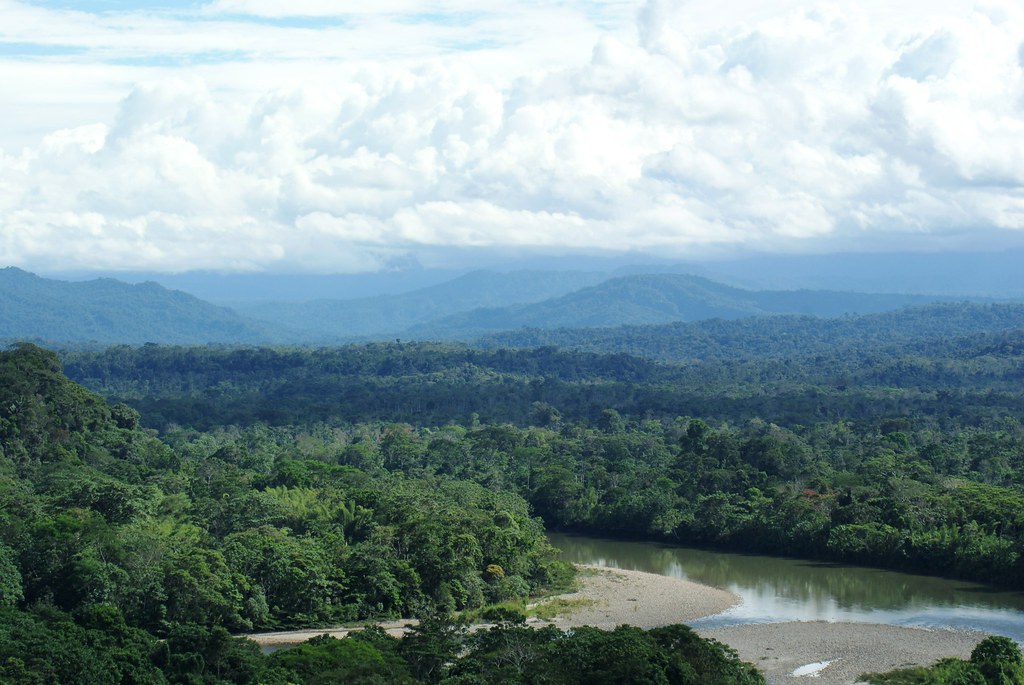
Photo: Ecuadorian Amazon rain forest, looking toward the Andes by Dallas Krentzel, CC BY 2.0.

Author: Safe Ceremonies
User reviewed ceremonies