Ayahuasca myths: what’s true and what isn’t
Ayahuasca attracts strong stories. Some come from retreat marketing, some from podcasts and friends, and some from the traditions themselves, passed on without the context that gave them meaning. A few are harmless. Others can lead people into decisions that put them at risk.
This guide takes the claims you’re most likely to hear and checks them against what is known. Where the honest answer is “nobody knows yet,” it says so. It doesn’t question anyone’s faith. A tradition can hold that the plant is a teacher or that the ceremony is a prayer, and that belief needs no proof. The myths here are claims about your body, your mind, the law or the past that can be checked.
Myth 1: “Ayahuasca is just DMT you drink”
The brew is usually made from two plants. The leaves of a shrub such as Psychotria viridis supply DMT. The bark of the Banisteriopsis caapi vine supplies harmine, harmaline and tetrahydroharmine. A review in Current Neuropharmacology explains that harmine and harmaline block the enzyme MAO-A, which would otherwise destroy the DMT in the gut and liver, and that tetrahydroharmine weakly blocks the reuptake of serotonin.
So the vine does more than “unlock” the DMT. It has effects of its own, it is the reason the brew lasts hours rather than minutes, and it is behind the most serious medicine interactions.
Myth 2: “It’s natural, so it’s safe”
The US National Center for Complementary and Integrative Health has a page devoted to this idea, explaining that natural doesn’t necessarily mean safer or better, and that everything, natural or not, is made of chemicals.
For ayahuasca specifically, the largest study of side effects, the Global Ayahuasca Survey of 10,836 people, found that about 70% had acute physical effects, mostly vomiting, and 2.3% needed medical attention afterwards. The review in Current Neuropharmacology warns that combining ayahuasca with SSRI antidepressants could cause serotonin syndrome, a potentially dangerous reaction, and that ayahuasca could bring on psychosis in people who are predisposed. “Natural” says nothing about any of this.
Myth 3: “People have drunk it the same way for thousands of years”
The history is real and also more complicated than the marketing. In 2019, archaeologists described a ritual bundle about 1,000 years old from a cave in the Bolivian Andes, holding a pouch with traces of DMT and harmine, the key compounds of ayahuasca. That is the oldest direct chemical evidence so far that people combined plants this way. How much older the practice is, and how widely it was used, is still debated.
Many of the forms you’ll meet today are much newer. Brazilian churches that use ayahuasca as a sacrament took shape in the 1930s, combining Christian and Indigenous elements. Retreats for international visitors, with set packages and English-speaking facilitators, are newer still. None of that makes them bad. It means “ancient” is often a description of a plant, not of the particular ceremony you’re booking.
Myth 4: “One ceremony will cure your depression, addiction or trauma”
Research on ayahuasca and mental health is promising and early. The best-known controlled trial, published in 2019, gave ayahuasca or a placebo brew to 29 people with treatment-resistant depression in Brazil and found larger improvements in the ayahuasca group over the following week. The authors stressed that the sample was small, that blinding was hard, and that the results couldn’t simply be extended to other kinds of depression. Studies of long-term church members have found lower scores on measures of alcohol problems than in comparison groups, but those are observational studies of a particular community.
No regulator has approved ayahuasca as a treatment. A center that promises a cure is claiming more than the evidence supports. Our guide on grounded and woo-woo language covers how to read those promises.
Myth 5: “Whatever happens is part of the healing”
Many people do find meaning in hard experiences, and the Global Ayahuasca Survey reflects that: of the roughly 56% who reported difficult mental health effects in the weeks or months afterwards, about 88% saw them as part of a positive process of growth or integration. The same survey also found that around 12% sought professional help for those effects.
Both are true. A frightening night or a hard few weeks can be part of a meaningful process, and it can also be a sign that you need support. If you’re struggling weeks later and a facilitator’s only advice is another ceremony, look for other help as well. Our guide to difficult experiences after a ceremony lists where to start.
Myth 6: “The purge is your body releasing toxins”
Vomiting, and often diarrhea, are common after drinking ayahuasca. Many traditions treat them as cleansing, physical and spiritual, and that is a belief you can respect. The review in Current Neuropharmacology explains the bodily side differently: serotonin stimulating the vagus nerve. We know of no study showing that the purge removes measurable toxins from the body.
The practical risk is that “it’s just the purge” gets stretched over signs that need medical attention, such as fainting, chest pain, a seizure or someone who can’t be roused. A careful center knows the difference.
Myth 7: “Ayahuasca is addictive, like other drugs”
This one runs the other way. The evidence so far doesn’t suggest ayahuasca causes dependence. A 2010 study of ritual users in Brazil found they scored lower than comparison groups on alcohol use and psychiatric measures of an addiction severity index, and found no sign of the harms typical of drugs of abuse. The review in Current Neuropharmacology concludes that, used appropriately, it does not appear to carry risks of abuse or dependence.
That doesn’t make it low-risk, as the other sections show. Its risks are different ones.
Myth 8: “It releases the DMT stored in your pineal gland”
A popular idea holds that the pineal gland, a tiny gland in the brain, releases DMT at birth, in dreams and at death. In a 2018 paper titled “N,N-dimethyltryptamine and the pineal gland: separating fact from myth,” the pharmacologist David Nichols wrote that the scientific evidence is not consistent with this. The adult pineal gland weighs less than 0.2 grams and mainly makes the hormone melatonin, and the tiny amounts of DMT found in the brain aren’t enough to produce psychedelic effects. The DMT in ayahuasca comes from the leaves in the brew.
Myth 9: “It’s legal in Peru, so retreats there are regulated”
In 2008, Peru’s National Institute of Culture declared the traditional knowledge and uses of ayahuasca by Amazonian Indigenous communities part of the nation’s cultural heritage. According to Peru’s state news agency, the resolution set traditional, sacred use apart from what it called decontextualized, consumerist and commercial Western uses.
That declaration protects a tradition. It doesn’t set up licences, medical standards or inspections for retreats, and it doesn’t tell you anything about a particular center. Laws in every country change, and this is a description, not legal advice. Our guide to ayahuasca in Peru covers more.
Myth 10: “The medicine chooses who comes, so screening isn’t needed”
This one is a belief being used in place of a safety step. The Global Ayahuasca Survey found that physical problems were more likely in people who had a physical health condition or drank outside a supervised setting, and mental health problems were more likely in people with anxiety disorders. Those are exactly the things screening is designed to catch. A center that waves screening away with spiritual language is skipping its job.
More guides
- What ayahuasca is
- What happens in an ayahuasca ceremony
- Ayahuasca and mental health: what the research says (and doesn’t)
- Grounded or “woo woo”? How to read a group’s beliefs
- Health screening: why a good center asks about your health
- Ayahuasca in Peru: what to know before you go
Past participants’ reviews are a good test of whether a center believes its own myths: how it talked about risk, screening and hard nights, and what it said afterwards. You can search the Safe Ceremonies listings, starting with the ayahuasca category and integration and aftercare support.
Sources
- Hamill J, Hallak J, Dursun SM, Baker G (2019). Ayahuasca: psychological and physiologic effects, pharmacology and potential uses in addiction and mental illness. Current Neuropharmacology, 17(2). https://pmc.ncbi.nlm.nih.gov/articles/PMC6343205/
- National Center for Complementary and Integrative Health. Natural doesn’t necessarily mean safer or better. https://www.nccih.nih.gov/health/know-science/natural-doesnt-mean-better
- Bouso JC, Andión Ó, Sarris JJ, et al. (2022). Adverse effects of ayahuasca: results from the Global Ayahuasca Survey. PLOS Global Public Health, 2(11). https://pmc.ncbi.nlm.nih.gov/articles/PMC10021266/
- University of California, Berkeley (2019). Ayahuasca fixings found in 1,000-year-old bundle in the Andes (on Miller MJ et al., Proceedings of the National Academy of Sciences). https://news.berkeley.edu/2019/05/06/ayahuasca-sacred-bundle/
- Palhano-Fontes F, Barreto D, Onias H, et al. (2019). Rapid antidepressant effects of the psychedelic ayahuasca in treatment-resistant depression: a randomized placebo-controlled trial. Psychological Medicine, 49(4). https://pmc.ncbi.nlm.nih.gov/articles/PMC6378413/
- Fábregas JM, González D, Fondevila S, et al. (2010). Assessment of addiction severity among ritual users of ayahuasca. Drug and Alcohol Dependence, 111(3). https://pubmed.ncbi.nlm.nih.gov/20554400/
- Nichols DE (2018). N,N-dimethyltryptamine and the pineal gland: separating fact from myth. Journal of Psychopharmacology, 32(1). https://pubmed.ncbi.nlm.nih.gov/29095071/
- Agencia Andina (2008). Declaran Patrimonio Cultural de la Nación a los conocimientos y usos tradicionales del ayahuasca. https://andina.pe/ingles/noticia-declaran-patrimonio-cultural-de-nacion-a-los-conocimientos-y-usos-tradicionales-del-ayahuasca-184254.aspx
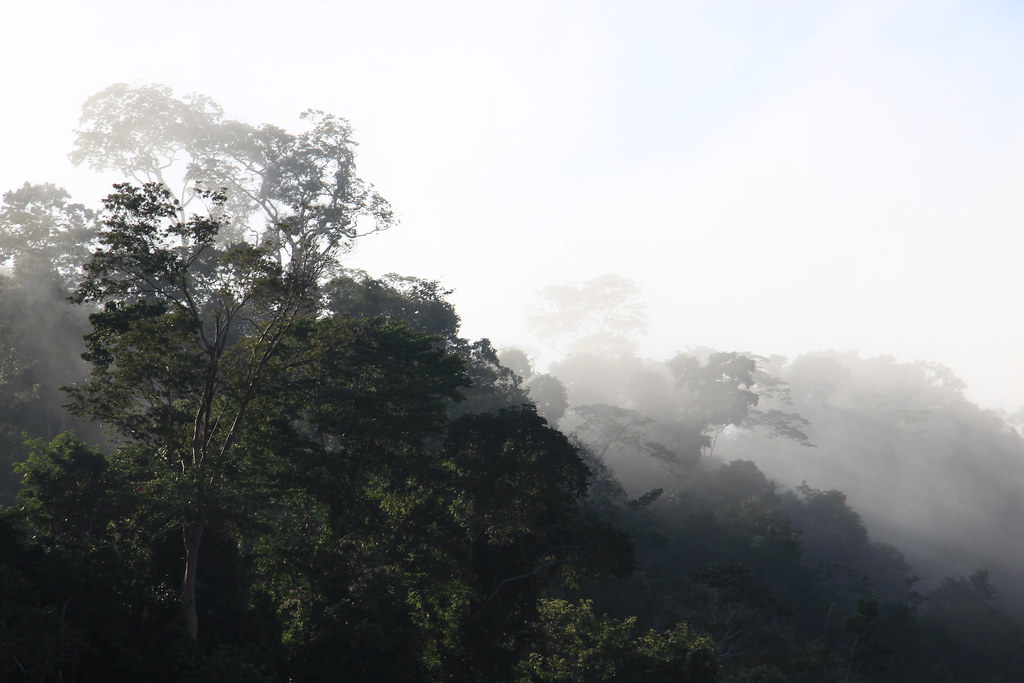
Photo: Misty rainforest by Leon Beckert, CC BY-SA 2.0.

Author: Safe Ceremonies
User reviewed ceremonies