Yagé ceremonies: the Colombian ayahuasca tradition
If you’ve seen a “yagé ceremony” advertised, in Colombia or in a city far from it, you may have wondered whether it is the same thing as an ayahuasca ceremony. It is the same brew under another name. The tradition around it is a different matter. Yagé belongs to particular Indigenous peoples in the south of Colombia, who have their own healers, their own rules, and their own view of how it should be shared with outsiders.
This guide explains the name, the peoples who hold the tradition, what a taita is, how a ceremony is usually described, and what to ask before you sit in one. It isn’t a legal or medical guide. For the law, security and travel health, read our guide to ayahuasca in Colombia. This guide was checked on 2026-11-16.
What the word means
Yagé, also spelled yajé, is one of many names for the brew that most English speakers call ayahuasca. A 2019 review in Current Neuropharmacology lists it beside hoasca, caapi, daime, natem and others. Yagé is the usual name in Colombia.
The ceremony has its own word too. The Colombian anthropologist Alhena Caicedo Fernández, who has studied these ceremonies for years, writes that people there call it a toma de yajé, or simply a toma. The word means a drinking, or a taking.
The peoples who hold the tradition
Caicedo Fernández places yagé among the Indigenous peoples of the Amazon foothills in southwestern Colombia, in the Putumayo and Caquetá regions. She names the Inga, the Kamëntsá, the Cofán and the Siona. The healers’ own union, described below, also includes the Coreguaje, and healers from the Tatuyo and Carijona peoples came to its founding gathering.
These are separate peoples with separate languages, and the land they come from is older than the borders drawn across it. The anthropologist Esther Jean Langdon, who began working with the Siona in 1970, writes that they descend from peoples who lived along the Caquetá, Putumayo and Aguarico rivers, in what is now Colombia, Ecuador and Peru.
The tradition has not stayed still. In the Siona community where Langdon worked, the last leading healer died in the 1960s, and for years nobody led the community’s yagé ceremonies. People drank with healers from neighboring peoples. Later the Siona took up their own ceremonies again. Langdon and her co-authors, one of them a Siona taita, describe today’s taitas as traditional authorities who also speak for their communities in defending their land.
What a taita is
Taita is the word you’ll hear most. The healers’ code of ethics explains that it is an Inga word for father, used for grandparents and elders in general, and in some places for community governors. It is mostly a term of respect. The code adds that the word “does not always mean a traditional healer.”
Each people has its own name for its healers, and many accept the older Spanish-era word curaca. The healers who wrote the code say they have never called themselves shamans. The term they prefer is “indigenous yagé doctor.” Their documents also speak of knowledgeable women, and of women who know a great deal about medicinal plants.
The code is plain about how someone becomes a healer. Nobody studies it in a school. An apprentice learns under one elder, follows the restrictions that elder sets, and stays an apprentice for as long as the elder lives. The code says this is “not a matter of a few days or months.”
Nobody outside can hand out the title either. In the code’s words, “our elders, our traditional authorities, and our brethren are the ones who will extend recognition to us.” A healer, it says, has to take a full part in the life of their own community.
How a toma is usually described
Practice differs from people to people and from healer to healer. The code itself says each taita has “unique ways of working.” The descriptions below come from the healers’ own documents and from anthropologists. They are not a script.
- It happens at night. UMIYAC, the healers’ union, writes of “the long nights of the rituals,” with a fire burning.
- The code calls for a ceremonial house built away from the main house, ideally in the forest, and used only for ceremonies.
- The taita leads the whole night. In a photograph from a 2019 Siona ceremony, published with Langdon’s article, the taita prays over the yagé before he serves it.
- There is music. The code mentions crowns of feathers, rattles and other instruments, and says the ceremonies include songs and dances. Langdon writes that among the Siona the healer sang through the night, and that his songs guided the people drinking with him.
- The group matters. UMIYAC calls the ceremonies “sacred and social,” a time when people analyze problems, share what they know and laugh together. It also says there is “much suffering,” and that the medicine “tries the individual.”
- In the morning the healer speaks. Langdon describes the Siona healer telling the group what he saw during the night and giving advice. Today, she writes, Siona ceremonies are often followed by community assemblies.
In the cities, Caicedo Fernández describes tomas as private gatherings that people hear about by word of mouth. They are always led by a specialist, most often a taita from the Putumayo. She also mentions the personal cleansings that taitas carry out during a toma.
For the practical side of a night with the brew, such as where you sit, how long it lasts and what your body may do, see our guide to what happens in an ayahuasca ceremony.
UMIYAC and the healers’ code
UMIYAC stands for Unión de Médicos Indígenas Yageceros de la Amazonía Colombiana, the Union of Indigenous Yagé Healers of the Colombian Amazon. Healers from several peoples met in Yurayaco, in Caquetá, in June 1999 and agreed to form it. UMIYAC says it brings together five peoples: the Cofán, Inga, Siona, Coreguaje and Kamëntsá.
Its code of ethics was approved and signed at a meeting on the Putumayo River in July 2000. The healers gave it a second name, “The Beliefs of the Elders.” They are careful about its reach. It is presented on behalf of the peoples of the yagé culture in Colombia, and “it speaks for no one else.”
Our Colombia guide lists the code’s rules on selling yagé, on money and on alcohol. Other parts are just as useful to a visitor:
- Healers vow not to seek publicity or advertise their services. The code says the people they have helped should be the ones who recommend them.
- A healer who can’t help someone should send them to another Indigenous doctor or recommend a different kind of medicine.
- The code says its authors need modern medicine in their communities. It names emergencies, injuries and surgery among the things Western doctors treat and they do not.
- Ceremonies should be carried out with great respect, in a proper ceremonial space.
In November 2019 UMIYAC and other Indigenous organizations published a declaration on cultural appropriation. It says communities know who their true healers are, through reputation, wisdom and lineage. It warns about young people who “disguise themselves with feathers and necklaces” and call themselves taitas without the knowledge behind the title. It says no healer or authority can certify a non-Indigenous person to lead yagé ceremonies. It also objects to events that mix yagé with unrelated practices.
That is the position of the organizations that signed it. Other healers and other peoples may see things differently. It is still the clearest statement you can read, from inside the tradition, of what its holders consider legitimate.
How yagé reached the cities and other countries
Yagé has been in Colombian cities for a long time. Writing in 2009, Caicedo Fernández said it had been present in Bogotá for at least forty years, mostly among working-class migrants from the countryside. Interest from intellectuals, artists and doctors began in the late 1980s, when well-known taitas were invited to lead ceremonies in the city. From about the mid-1990s, tomas spread through cities such as Bogotá, Medellín, Cali and Pasto.
The ceremonies changed as they spread. She describes the tomas of the mid-1990s as small, with no more than twenty people and a voluntary contribution. Later came mass ceremonies of around a hundred people, each paying to attend. Younger Indigenous people with more or less training began to hold tomas of their own. Go-betweens appeared, along with workshops and talks. In many places, she writes, the Indigenous specialist was slowly pushed aside, and the taita’s personal cleansings gave way to each person’s own free experience.
The healers saw this early. Their code, written in 2000, says that many people, “indigenous doctors or not,” were traveling to the big cities to hold ceremonies. Some did it as a service. Often, the code says, it was done for profit, and sometimes it involved charlatanism.
Yagé ceremonies are now offered well beyond Colombia. The 2019 declaration speaks to that international public directly. It describes retreats, “ayahuasca tourism,” schools of shamanism and offers on social networks, some of them run by people with no tie to any Indigenous community.
What to ask before you sit in a yagé ceremony
You can ask these questions politely, and a healer who works with care will have heard them before.
- Who is the taita? Which people and community do they belong to, who taught them, and for how long?
- Who recognizes them as a healer: their elders, their community’s authorities, an Indigenous organization? Can I find that out from someone other than the organizer?
- Do they still live and work in their community, or return to it? Does any of what I pay go back there?
- If the person leading is not Indigenous, who do they say authorized them, and what do they say about the 2019 declaration?
- How does the screening work? Who asks about my health and my medicines, and what do they do with my answers?
- How many people will drink, and how many helpers will stay sober and watch the room?
- What happens if someone is unwell in the night? Who decides to call for help, and how far away is a hospital?
- Will anything other than yagé be offered, before, during or after?
Health questions come first. Our guides on health screening before a ceremony and on medications and health conditions explain what a careful host asks and why. On numbers, see group size and staffing.
Good answers name people and places. A healer’s community is a real place, and their teacher is a real person. Be careful with a title that can’t be traced to anyone, with heavy advertising, and with a room so full that the taita can’t see everyone in it. The healers’ own documents warn about the first two.
If you’re traveling to Colombia for this, read our guide to ayahuasca in Colombia first. It covers known incidents, regional security warnings and health precautions. For other countries, see plant medicine laws around the world.
More guides
- Ayahuasca in Colombia: what to know before you go
- Ayahuasca traditions: Shipibo, Santo Daime, UDV and more
- Indigenous traditions and respectful practice
- Reciprocity and sustainability: the plants and the people behind them
- What happens in an ayahuasca ceremony
- What a center’s emergency plan should cover
Past participants can tell you who led a ceremony, how many people were in the room and what happened when someone struggled. You can search the Safe Ceremonies listings and read reviews in the ayahuasca category, and find support for afterwards under integration and aftercare.
Sources
- UMIYAC (2000). Code of ethics for the practice of Indigenous medicine in the Amazon piedmont of Colombia (“The Beliefs of the Elders”). https://umiyac.org/?p=2891
- UMIYAC and others (1 November 2019). Declaration about cultural appropriation from the spiritual authorities, representatives and Indigenous organizations of the Amazon region. https://umiyac.org/2019/11/01/declaration-about-cultural-appropriation-from-the-spiritual-authorities-representatives-and-indigenous-organizations-of-the-amazon-region/?lang=en
- UMIYAC. About us. Checked 16 November 2026. https://umiyac.org/about-us/?lang=en
- Caicedo Fernández A (2009). Nuevos chamanismos Nueva Era. Universitas Humanística, 68. https://revistas.javeriana.edu.co/index.php/univhumanistica/article/view/2264
- Caicedo Fernández A (2010). El uso ritual de yajé: patrimonialización y consumo en debate. Revista Colombiana de Antropología, 46(1). https://www.redalyc.org/pdf/1050/105015237003.pdf
- Langdon EJ, Laffay T, Maniguaje-Yaiguaje P (2023). Resistencias, re-existencias y prácticas chamánicas: las poéticas y políticas de una visión contemporánea. Mundo Amazónico, 14(1). https://revistas.unal.edu.co/index.php/imanimundo/article/view/104431
- Hamill J, Hallak J, Dursun SM, Baker G (2019). Ayahuasca: psychological and physiologic effects, pharmacology and potential uses in addiction and mental illness. Current Neuropharmacology, 17(2). https://pmc.ncbi.nlm.nih.gov/articles/PMC6343205/
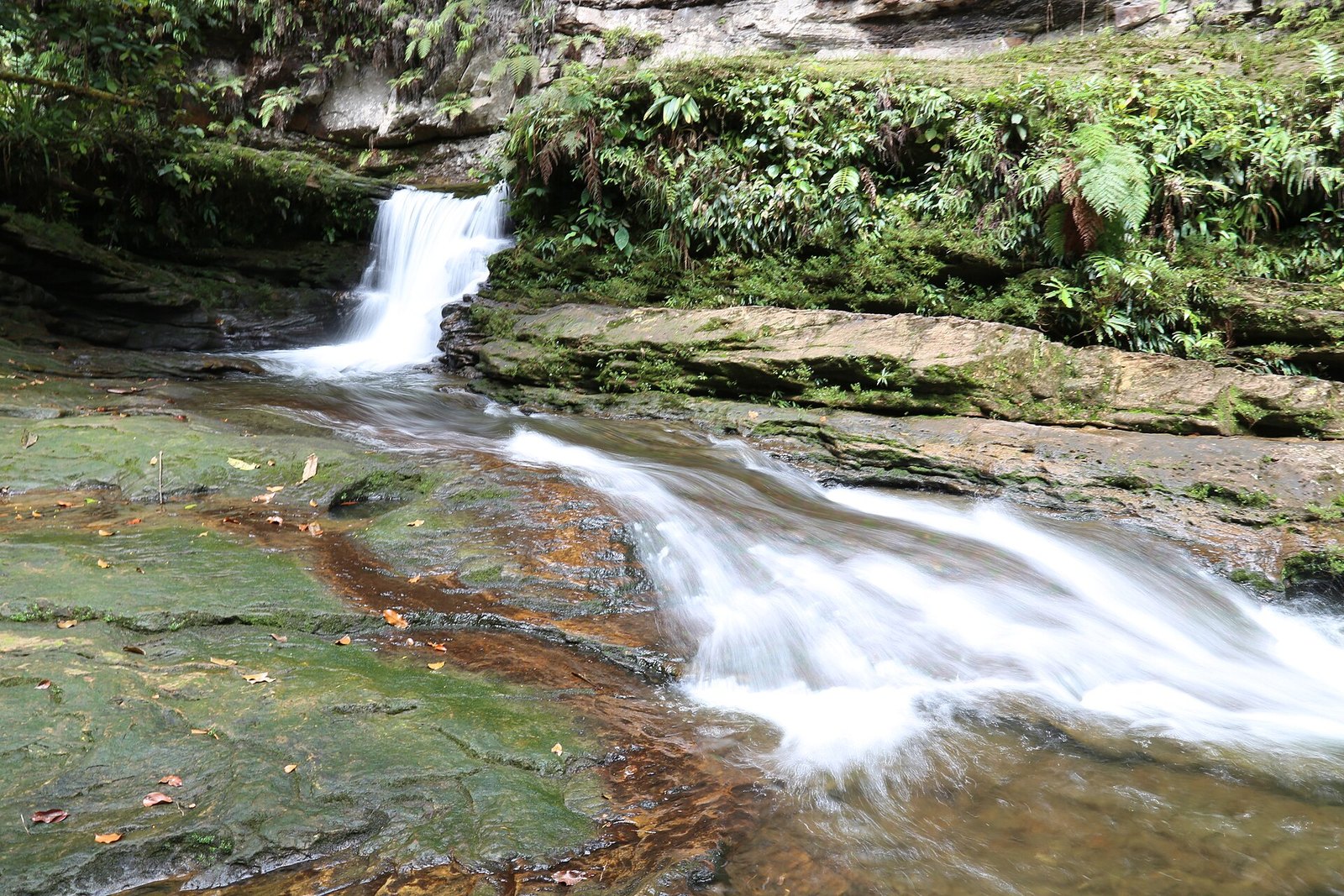
Photo: Fin del Mundo, Mocoa, Putumayo – panoramio by CarlosE Duarte, CC BY 3.0.

Author: Safe Ceremonies
User reviewed ceremonies